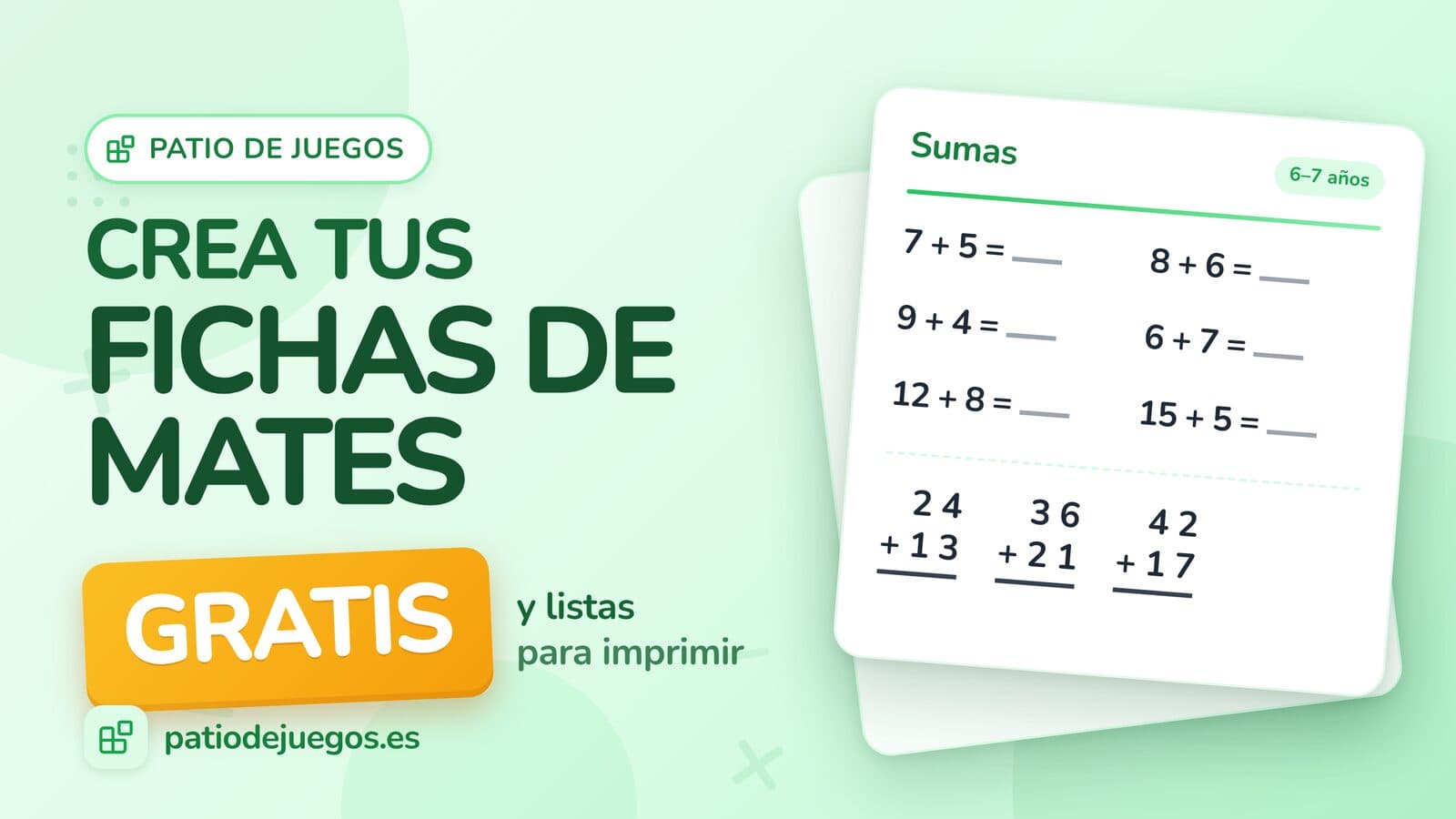
Mental math by grade: ages 6, 7 and 8
In the first year of primary school, a child usually adds and subtracts up to 10 in their head and knows the pairs that make 10. In the second year, they cross the ten (8 + 5), add and subtract whole tens, and start on the 2, 5 and 10 times tables. In the third year, they know every table and add two-digit numbers in their head. That is the order the textbooks follow, year by year, and it is a guide rather than a test.
It helps to know where that order comes from. The Spanish primary curriculum (Royal Decree 157/2022), which this site is built around, does not speak of years at all, only of two-year cycles: for years 1 and 2 together it asks for numbers "up to 999" and for "addition and subtraction of natural numbers solved with flexibility and sense". Nothing more. What lands in year 1 and what waits for year 2 is decided by the publishers, which is why two schools can go in a different order and neither is wrong. What follows is the order the most widely used practice books take, which is what your child sees in class.
What counts as mental math in primary school?
Adding in your head means using a trick instead of counting: for 8 + 5, thinking "8 and 2 make 10, and 3 more, 13". There are four such tricks, taught one at a time, and we explain them in mental math for kids. This article answers a different question: which of those tricks belongs to which year, and with which numbers.
One rule before we start: mental math always runs one step behind what the child does on paper. First they add with objects, then with fingers, then in the exercise book, and only when that comes without hesitation, in their head. If your child still counts blocks one by one, start with how to teach addition and come back in a few months.
Year 1 (ages 6 and 7): up to 10 without counting
Year 1 books work with numbers up to 99, but the mental math of that year lives inside 10. By the end of year 1, a child usually does these things in their head:
- Add 1 or 2 to any number up to 20 without starting again from one.
- The pairs that make 10: 7 and 3, 6 and 4, 8 and 2, 9 and 1.
- The small doubles: 2 + 2, 3 + 3, 4 + 4, 5 + 5.
- Take away 1 or 2, and subtract within 10 once the matching addition is known.
Carrying (27 + 15) arrives at the very end of the year, and on paper. Nobody expects a year 1 child to do it in their head. Borrowing does not appear in year 1 at all.
The thing most worth practising at home this year is the pairs that make 10, because everything afterwards rests on them. The number bonds worksheets print the houses with the total on the roof and the pairs underneath, and the number bonds game does the same without printing anything.
The sign that a child is behind: in the last term of year 1 they still count from one for 6 + 3. That means they have not reached "count on from the bigger number", which is the first trick and the one that takes longest.
Year 2 (ages 7 and 8): crossing the ten
In year 2 the numbers grow to 999 and mental math makes the jump that costs the most: crossing 10. By the end of year 2, the usual picture is:
- Sums to 20 that cross the ten: 8 + 5, 7 + 6, 9 + 4. The trick is to reach 10 and carry on.
- Subtractions within 20 of the same kind: 13 - 5, 15 - 7.
- Whole tens: 30 + 40, 70 - 20, and adding 10 to any number (46 + 10 = 56).
- The 2, 5 and 10 times tables, which come first because you can count in twos, fives and tens.
Borrowing on paper (52 - 27) comes in around the middle of the year. Again: on paper. In the head, year 2 subtracts small numbers.
For practice at home, the missing number works best: 8 + ? = 13, ? + 5 = 12. The missing number worksheet puts the gap on both sides, and that matters, because plenty of year 2 children solve 13 + ? = 20 and freeze in front of ? + 13 = 20. They can add. They still read the sum left to right, like a sentence.
For subtraction, the subtraction worksheets on easy give two-digit minus one-digit, which is exactly the size a year 2 child can begin to do in their head.
Year 3 (ages 8 and 9): the tables and two digits
In year 3, mental math becomes a daily tool, because multiplication and division need it. By the end of year 3:
- Every table up to 10. Knowing them by heart helps, but a child who gets 7 × 8 by thinking "7 × 4 is 28, and double that, 56" is doing fine: they understand what they are doing, and speed comes later.
- Two-digit sums in the head: 24 + 13 becomes "24 and 10 is 34, and 3 more, 37". That is the decomposing trick, with bigger numbers.
- Doubles and halves up to 100: double 35, half of 80.
- Multiplying by 10 and 100, and the first sharing: 12 sweets between 3.
The multiplication worksheets cover single tables, and the addition worksheets on medium give two-digit sums that can be done on paper first and, weeks later, in the head with the same sheet.
What if my child is behind this?
First, work out which year the problem belongs to. A year 3 child who gets lost in 8 + 5 does not have a year 3 problem: the year 2 piece is missing, crossing the ten, and probably the year 1 piece too, the pairs that make 10. Go back to the step that comes without hesitation and work on the next one, one only, until it comes on its own.
Second, do not time them. Hurry makes a child who used the trick yesterday go back to counting on fingers today. Five minutes a day in the kitchen or the car is worth more than half an hour of timed sheets.
Third, ask about the route and not the answer. "How did you work it out?" tells you which step they are on. "What is it?" only tells you whether they got it right.
Five minutes a day, by year
Year 1: pairs that make 10, back and forth. You say "7", they say "3". Swap the order, do it in the queue at the bakery.
Year 2: a number, and how far to the next ten. "Forty-six." "Four." Once that comes, sums that cross: "eight plus five".
Year 3: one table a week, out of order, and one two-digit sum a day out loud, with the route explained: "24 and 10, 34, and 3, 37".
If you do not know where to start today, ask them for 8 + 5 and watch what happens. If they count on from 8 with their fingers, the missing piece is the ten, and that is this week's practice.